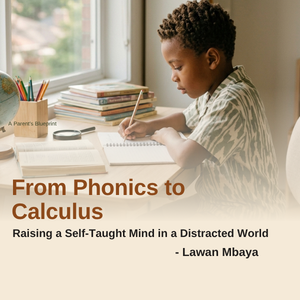
From Phonics to Calculus: A Parent's Blueprint for Raising a Self-Taught Mind in a Distracted World

Your child is in school five days a week — so why does none of it stay? From Phonics to Calculus is the parent's field manual for building a mind that actually learns, not just one that memorizes for Friday's test and forgets by Monday. From the first sound a child sounds out to the last derivative they'll ever solve, this is the missing curriculum: not what your child is taught, but how to make sure they actually learn it.
What to expect?
- 182 pages, 12 chapters, one continuous roadmap — from Learning How to Read through Mathematics: From Counting to Calculus, each chapter builds on the last instead of sitting as an isolated topic.
- Learning How to Learn — the meta-skill no school timetable has a period for, taught here as a teachable, practiceable system.
- Mastering Grammar and Learning Languages — language treated as architecture, not memorization; includes a practical approach to raising a bilingual mind.
- Building Wits — mental agility and discipline exercises that sharpen thinking the way physical training sharpens the body.
- The Digital Toolkit — a curated, subject-by-subject list of the apps and games actually worth your child's screen time, cutting through the noise of a thousand "educational" options.
- The Parent's Role: Guide, Not Teacher — a chapter that resets the entire premise of home learning, showing you exactly where to lead and where to step back.
- Putting It All Together — a closing roadmap that turns eleven chapters of principle into a week-by-week plan you can actually run.
Why it's essential?
Nigerian classrooms are built for coverage, not mastery — a teacher racing a syllabus for forty pupils has no time to check whether your child actually understood, only whether the topic was "taught." From Phonics to Calculus is what closes that gap at home. It doesn't ask you to become a teacher or hire another lesson tutor; it hands you the underlying mechanics of how reading, writing, mathematics, and thinking are actually built in a developing mind, in the order they're built, so that every hour your child spends in a classroom compounds instead of evaporating. If you've ever watched your child "pass" a topic and then completely blank on it a term later, this book is the reason why — and the fix.
CHAPTER 1: THE FOUNDATION – Why Self-Learning Changes Everything
1.1 The Case Against Passive Education
1.2 Why Traditional Schooling Fails the Brightest Minds
1.3 The Science of Self-Directed Learning
1.4 Breaking the Mobile Addiction Cycle
1.5 Building Intellectual Capacity from Day One
CHAPTER 2: LEARNING HOW TO READ – The Gateway to Everything
2.1 Phonics vs. Whole Language – What Actually Works
2.2 The First 100 Words Every Child Must Know
2.3 Read-Aloud Strategies That Build Comprehension
2.4 From Decoding to Fluency in 90 Days
2.5 Recommended Reading Lists by Age and Ability
CHAPTER 3: LEARNING HOW TO LEARN – The Meta-Skill
3.1 The Feynman Technique for Children
3.2 Spaced Repetition Made Simple
3.3 How to Take Notes That Actually Work
3.4 Teaching Your Child to Teach Themselves
3.5 The Pomodoro Method for Young Minds
CHAPTER 4: LEARNING HOW TO WRITE – From Scribbles to Essays
4.1 The Stages of Writing Development
4.2 Handwriting vs. Typing – What Matters When
4.3 Grammar Without Tears
4.4 The 5-Paragraph Essay and Beyond
4.5 Creative Writing That Doesn’t Feel Like Homework
4.6 Dictation and Copywork Methods
CHAPTER 5: MASTERING GRAMMAR – The Architecture of Language
5.1 Parts of Speech Made Understandable
5.2 Sentence Structure Demystified
5.3 Punctuation That Makes Sense
5.4 Common Errors and How to Fix Them
5.5 Grammar Games That Work
CHAPTER 6: LEARNING LANGUAGES – Bilingual Brains
6.1 The Optimal Age Window for Language Acquisition
6.2 Immersion Techniques for Home
6.3 Best Apps and Resources by Language
6.4 Maintaining Multiple Languages
CHAPTER 7: MATHEMATICS – From Counting to Calculus
7.1 Number Sense – The Foundation of All Math
7.2 Arithmetic Without Tears
7.3 Algebra – The Great Filter
7.4 Geometry – Seeing the World Differently
7.5 Trigonometry and Pre-Calculus
7.6 Calculus – The Language of Change
7.7 Mathematical Thinking vs. Rote Memorization
CHAPTER 8: LEARNING INTELLECTUALLY – Beyond the Curriculum
8.1 How to Read a Non-Fiction Book
8.2 Asking Better Questions
8.3 Critical Thinking for Kids
8.4 Logic and Reasoning
8.5 Research Skills That Scale
8.6 The Art of Debate and Discussion
CHAPTER 9: BUILDING WITS – Mental Agility and Discipline
9.1 Focus and Concentration Training
9.2 Memory Techniques for Students
9.3 Problem-Solving Frameworks
9.4 Mental Math and Quick Thinking
9.5 Games That Build Intelligence
9.6 The Role of Physical Exercise in Cognitive Development
CHAPTER 10: THE DIGITAL TOOLKIT – Best Apps and Games by Subject
10.1 Android Apps That Educate (Not Distract)
10.2 iOS Apps That Build Real Skills
10.3 Educational Games Worth Your Time
10.4 Screen Time Management That Works
10.5 YouTube Channels That Teach (Not Waste Time)
CHAPTER 11: THE PARENT’S ROLE – Guide, Not Teacher
11.1 Creating the Learning Environment
11.2 When to Step In, When to Step Back
11.3 Motivation Without Bribes
11.4 Tracking Progress Without Micromanaging
11.5 Dealing with Resistance and Frustration
CHAPTER 12: PUTTING IT ALL TOGETHER – The Roadmap
12.1 Ages 2–5: The Foundation Years
12.2 Ages 6–10: Building Independence
12.3 Ages 11–14: Deepening Understanding
12.4 Ages 15–18: Mastery and Beyond
12.5 The Lifelong Learner Mindset
Get Your Copy Today
When you purchase, you get:
✅ The complete book (12 sections covering reading, writing, grammar, languages, mathematics, intellectual development, and more)
✅ The Master Workbook (Daily Activities, Tracking Sheets, Reflection Questions, Troubleshooting Guides, Checklists)
✅ Lifetime access
✅ Free updates
What you're really getting:
- A system worth over ₦250,000 in premium content
- 12 weeks of structured daily activities
- Comprehensive tracking tools
- Proven strategies tested by thousands of Nigerian families
- A complete roadmap from phonics to calculus
This is not just a book. It's a school on its own. It doesn't replace conventional education—it inspires parents to do more.
Your child's future is worth more than just a ₦5,000 investment.
[BUY NOW – GET INSTANT ACCESS]
Payment options: Bank Transfer, USSD, Card, Paystack